HUMAN CONSCIOUSNESS
One primary fact of human existence is consciousness because it is present to, or underlies, every experience of every possible kind. Its nature and various states or modes are central to the human 'psyche'. Paradoxically, however, one of the most fundamental assumptions of Western science, though not always clearly expressed and simply assumed, is the primacy of matter over consciousness. The assumption is that materialism sees consciousness as a product of the sense data and that consciousness, which apparently (though unproven) has a potentially infinite grasp, arises from finite matter and that its development is (exclusively) dependent on material causes.
This assumption arises partly from the apparent fact that matter is observed to exist and persist and change independently of the consciousness of each individual person, while consciousness is generally experienced as limited to each person and appears to be dependent on the functioning of the living, functioning brain. However, in practically all world cultures, individuals have asserted that consciousness can be and is experienced as transcending all material and bodily conditions. Many recorded 'para-psychological phenomena' throughout history, though not investigated satisfactorily by the sciences so far, would seem to bear out the validity of such accounts.
That the primacy of matter over consciousness is an assumption, meaning
that it is not a proven fact. The opposite assumption, that consciousness is the ultimate cause and basis of existence is widely held in religious philosophies or theologies in the
Eastern tradition (especially the variants of Vedanta) - also found and often classified as 'idealism' in European thought
in neo-Platonic thinkers (Plotinus) and some philosophers (Berkeley) as well as in imported theories
from East to West from Vedantic thought, from Madame Blavatsky to Paul Brunton. Mentalism
would dispute the materialist assumption that consciousness arises from or is limited
to the physical senses, yet it remains a mere assumption itself. In mentalism, consciousness takes primacy over consciousness
and is (supposedly) infinite in its scope. plus many alleged 'spiritual masters') or in the 'solipsism' of ancient Greeks like Protagoras and also in numerous New Age 'spiritual' theories. Their common presumption is that - whatever
common sense may seem to suggest - consciousness does not depend for its existence
on matter. It is considered not to be not generated through physical sensations of
material events. Depending on the variant of such mentalism involved, this does not necessarily apply to the mind and its various 'contents',
such as all the specific perceptions, sensations, thoughts, emotions, ideas,
desires, mental pictures etc. of which we can be aware.
All experiential phenomena,
whether physical, mental or spiritual, are here regarded as being 'objects'
of a person's consciousness, which is experiences itself as a purely subjective and private (outwardly not directly penetrable and as being
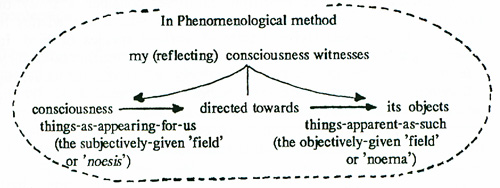
'inner'). 'Phenomena' here means that the objects of consciousness are 'what
appear or are shown as being given to my awareness'. The following diagram helps explain this:-
The attempts of the experimental sciences to investigate consciousness in
search of a physical basis has become empirically stronger as technologies (like magnetic resonance imaging with vast computational powers of analysis) and neurological observation and experimentation have been developed.
Consciousness has therefore no longer proven to be entirely impenetrable to scientific
analysis and experiment. Moreover, many psycho-active agents, from old time cannabis, opium, morphine, mescaline to a host of newly discovered 'psychedelic' chemicals frequently cause experiences that are indistinguishable from those described by all manner of mystics East and West. In 'The Blissful Brian' by London's University College researcher in neurology and meditation, Dr. Shanida Nataraja, an expert practitioner in many traditional forms of meditation, has studied a range of mind-changing substances (LSD, DMT, mescaline, cannabis, and ketamine) and is convinced that the effects that can be achieved through these are no different from what mystics describe as their highest experiences, all of which are also only temporary. One famed mystic who fell into blissful trances utterly detached form 'the world', Ramakrishna Paramahamsa, made it very clear that the body organism cannot sustain itself indefinitely while being 'lost to the real world'. However, some still claim for their own purposes that they have it constantly, which is unproved and most likely a sustained deception for many personal reasons including control of followers and accumulation of worldly goods.
In the C20, some scientists explained consciousness as a kind of side-effect of existence - an 'epi-phenomenon' - or the perceived reflection of brain activity and not a direct phenomenon (or epistemological object) in itself.
The former failures of most of the scientific community to admit the likelihood of differing kinds of
experience and phenomena of an apparently 'extra-sensory' kind increasingly provided dissidents with religious/mystical leanings with some reasons for
rejecting the materialistic thesis in favour of its contrary, mentalism or spiritualism and so forth. This leads into rational conjecture and hopeful speculation about the likelihood of an 'individual soul' and even a unifying 'spirit' (usually a God). These ancient beliefs have so far never produced anything remotely like scientifically-controllable evidence, mot least also because until the computer revolution, scientific instrumentation was virtually primitive in comparison to its vast exponential expansion to the present time. Around the turn of the century to 2000, great ingenuity and enormous efforts on many fronts in modern psychology,
physiology, neurology and a range of allied sciences, has begun to lay the empirical basis for a theory of the functions and eventually of the nature of consciousness. The mentalist or spiritual view is
allied to all manner of age-old beliefs that spirits cause everything and develops into doctrines that spirit suffuses the cosmos, being
itself wholly immaterial. Spirit, qua God in some form or other, even came to fill the ultimate role of creator and regulator of the cosmos (or universe). This very soon leads
into a quagmire of paradoxes, contradictions and denials of experience. Without going into too much detail here, the peculiar thesis of
the primacy of consciousness versus matter (as in mentalism (eg Brunton) Indian dualism (dvaita), and non-dualism (advaita), the idealism of Berkeley and various modern equivalents by isolated 'theorists', leaves many central issues completely
unsolved. Physical
materialism of that thesis also implies that many widely-held beliefs of mankind
are false, from belief in anything that is not
either directly given to our sensory equipment or perceptible by the use of instruments, and the resulting scientific world endeavour and the practical knowledge flowing from it has totally altered for the common good practically every aspect of individual and social life today.
Since the fact of being conscious seems to be closely related to the normal
functioning of the human brain, science regards consciousness as originating
only from the brain and as being totally dependent on it. There is no decisive or plausible proof that the brain is merely an instrument and channel of (some aspects of) an ever-present consciousness
emanating from 'out of this world'. From the viewpoint of mentalism, to suggest how consciousness may 'exist independently of the brain', spiritual adherents compare the brain to a radio or TV receiver and consciousness to the waves with various frequencies
to which the brain can be tuned in. Such an argument from analogy is logically invalid and is not to be considered seriously unless one wishes to enter the endless realms of empty - but possibly pleasing - conjectural dreaming. On the other hand, the development of artificial intelligence (AI) poses the question whether the brain's operations can eventually be copied (at least in part) by computers, and even used to enhance the brain through computer implants. Experimental steps are already being undertaken in implanting minor computer electronics.
MENTALIST EXPLANATIONS AND THEIR COUNTERPARTS
In any awareness of anything, consciousness cannot be an object.3 This is to say that consciousness 'intends its object', which is stated formally by Brentano as "Consciousness is always consciousness of an object' (where object mean 'object of perception' nor simply a material or sense object - hence this includes ideas, feelings, anything of which we become aware (as an 'intentional object').
The assumption of the primacy of matter over consciousness (i.e. ontological materialism) means that explanations of human behaviour must be traced back to natural-physical events or causes, such as instincts or drives like 'libido' and bodily needs that the organism needs for self-preservation, genetic predispositions and much more. The contrary assumption (i.e. the ontological primacy of 'consciousness') holds that such a procedure is incapable of understanding human behaviour in terms of meaning, purpose, goal, will and value. This purposive or goal-oriented view (i.e. 'teleological explanation') is in contradiction to the non-teleological view of natural science, which rejects the transcendental belief - that purpose or meaning is inherent in the universe independent of the human organism.
In the modern scientific view, individual human consciousness only develops through taking in sensory impressions, and this begins already in the womb as the organism receives impressions. These stimulate the developing brain into awareness, aided by genetically inherited instincts. Eventually human consciousness comes to combine countless impressions and make increasingly coherent sense out of them, identifying common forms in them and abstracting them as primitive 'ideas'. These multiply and go through countless mental transformations as the mind and memory develops and abstracts interconnections through language and develops its internal topographies. Without language, the mind would have only a low level of awareness, such as in those lower animals which have no means of mutual expression and mutual understanding upon which complex systems of knowledge can be raised. Through language alone can the specific human faculty which combines clarity of thought, idea consistency and communicable expression arise.
Since values cannot be observed per se (i.e. through the senses), intellect and moral judgement are supposed by mentalists to be somehow 'immaterial' and supra-physical phenomena, having objective and immutable being, independent of and beyond the physical organism. They somehow impinge their form on our awareness in advance of sense perception, and often it is further held that have a permanent and immutable form. A traditional idea of truth as an unchanging and unchangeable quality, which is argued shows that values are immutable forms (as in Platonic idealism). These mentalist contentions have been refuted by influential modern philosophers, notably since John Locke and subsequently by most modern thinkers in the scientific tradition. . whereby the independence of permanent unchanging values, ideas, pure essence and much else, is due to a bewitchment of the mind by language (whereby, for example, various abstract nouns create the illusion of their substantive existence). That conceptions of 'the' immutable truth is primitive, is shown not least by the fact that there is no consensus anywhere of what is the truth. Science aims at the truth about phenomena, but not a 'the truth' as such for it can only be the truth about something, just as 'time' is an idea which has no referent as a thing or existent, being but is a measure of intervals between events.. Science today will not endorse any claim of complete and uninfluenced 'objectivity' of knowledge, an 'eternal theory' or 'immutable wisdom' somehow existing independently of all brains, which are organisms that grow, change, and disintegrate. The origins of moral sense, conscience, values and all such cultural phenomena are easily explained without the assumption of spiritual realms or cosmic consciousness..
Reason requires that everything ultimately must either be generated from consciousness (sometimes called 'spirit') or from physical existence, no 'in-between view' is possible. Which of these most fundamental of assumptions is correct and most fruitful cannot be decided by pure reason, and not even as such by scientific method alone. Assumptions are to be judged by their fruitfulness in advancing our knowledge, understanding of what exists and how well these enable the human project to progress, materially, technologically, culturally and in eliminating the ills of the world. How one judges will depend on one's total experience and one's level of insight and intellectual grasp of the sphere human knowledge and culture.
It is held in science that the human mind and its faculties are of a very subtle electro-magnetic
and micro-biological nature, which can be measured by advanced scanning methods.
Consciousness has at long last been made scientifically more and more accessible through analyzing the neurons and their connections experimentally. This is still, of course, a project underway, yet the precision of these researches - using recently developed vast computational resources - are already far superior to the most involved argumentation of centuries of major thinkers who have tried to study the mind and/or consciousness without the benefits of science.
Modern psychology therefore increasingly rejects the proto-religious or 'spiritual-philosophical' assumption of the primacy
of consciousness and its merely speculative consequences because it promises a far more testable and satisfactory account of the
human mind, which is of course crucial to any psychology.5
There are both individual experiences and 'common experience'. Empirical science eventually accepts only what can commonly be observed or what can be validated by experiment. It excludes phenomena that are not widespread or which cannot commonly be observed. But all common experience is still based only on a number of individual experiences. Science therefore has a tendency to exclude the unique or exception to the rule and recognize only what is widespread and normal as its data. This 'common denominator' bias in empiricism can obviously be a source of error in psychology where individual experience can vary very greatly and is often quite unrepeatable (especially after it once occurred). This limitation need not apply, however, to the investigation of consciousness as a universal human faculty, but only to the unique and extremely variable contents or 'objects' of any private consciousness.
Many forms of self-discipline in the hope of developing or increasing conscious experiences have been known and practiced throughout the ages and these are clearly
described in many texts, ancient and new. These mostly hold that conditions or ' levels' of consciousness are experienced, such as described by mystics, through their subjective and private internal experience. This would thereby appear to exclude any other method, especially 'external' scientific research. However, in our interior relationship to our own awareness, we cannot become directly cognizant of 'consciousness' as such. This is because it always arises as consciousness of some intended 'phenomenal object' - whether a physical sensation, a memory of such, and idea or any inner mental 'representation', whether remembered or concocted. The psychic 'contents' - all the different forms
that consciousness may posit - can apparently cause it to vary in quality, range and
clarity
We discover on repeated and intense close reflection that consciousness
cannot be its own object, it cannot grasp itself as pure consciousness independent of some representation. It can be objectified through language - the word 'consciousness' (which entered common usage in the C20) is a lingual objectification and, being a noun suggests that it refers to an objective referent. This is a confusion due to 'language bewitchment' as described by Wttgenstein, whereby the idea obtains a bogus concreteness or substantivity (as an 'idea object').
None of this, however, obviates the validity of approaching consciousness or awareness through external means of the kind used in the latest neurological scanning techniques. 'Consciousness'
is referred to as a commonly described and reported feeling as if it were a directly observed phenomenon, which is not strictly so.
However its 'object content' can be described at length and related to direct observation in EEG and magnetic imaging technologies. Though awareness always comes with a phenomenal object, it cannot by any known means so far be separated from its passing contents, other than conceptually (but not experimentally). The functioning of the conscious mind and the presence, degree or even absence of its conscious aspect can be observed in real time scans of the brain's activities, showing their neural location, their electromagnetic intensity and much more that can be studied and further investigated from a neurological viewpoint both by experimental procedures and analytic thinking.
To be or to exist is inseparable from being conscious, even though the body may still be alive. Whether it is consider perhaps to be possible that consciousness can persist and exist without a live brain, this is a major bone of contention. The issue lacks decisive evidence either way, though there is massive testimony that consciousness and brain-functioning are inter-dependent. Reported experiences in meditation during scanning of the brain - as well in other connections including so-called 'out-of-body experiences' reported under various circumstances like and use of psycho-tropic agents and near-death experiences suggest that a complete divorce of consciousness from the physical body in space and/or time may occur. On-going researches into apparent awareness during temporary 'clinical death' from heart stoppage - and sometimes without measurable concurrent brain activity - are held by some to support the claim that consciousness can exist independently of the organism, though this is far from being widely verified by peer scientists. Alternative explanations of the reported subjective experiences have been put forward, especially in terms of altered brain chemistry after heart stoppage or the ingestion of substances like ketamine.4
The afore-mentioned speculation that the human mind or brain may be a (largely passive?) instrument of some independent or transcendental field of consciousness, which communicates to the brain from some higher level ' of awareness was mooted by Aldous Huxley (in 'The Doors of Perception' in 1954) where he wrote "And if, as I myself believe, visionary experiences enter our consciousness from somewhere "out there" in the infinity of Mind-at-Large, what sort of an ad hoc neurological pattern is created for them by the receiving and transmitting brain?" This 'brain is merely a kind of physical go-between' theory is held in religiously-influenced Indian thought which denies that the brain is the originator of consciousness or even thought, but a transmitter with limited capacities. It has even been suggested that the function of the human brain is to delimit consciousness and protect the self from massive flooding by infinite consciousness, so that it can distinguish sensory impressions from the physical world and think selectively by eliminating a destructive overflow of information. So as to overcome these limitations on consciousness thought to be due to its continuous 'attachment' to the physical body, many physical techniques (eg. yoga) and mental disciplines (meditation, chanting etc.) have been developed. They appear mostly to have only temporary, but if pursued intensively, can produce dramatic effects, including undesirable mental disturbances and cognitive disorder. Of course, there are no practical methods devised so far to test this kind of abstract belief.
This would seem to support the mentalist thesis of the primacy of consciousness over matter, but it is also compatible with the contradictory theories of physicalism. That the human brain is the product of an extremely process of selective evolution is scientifically indubitable and the resulting awareness and mental-emotional development of modern homo sapiens sapiens strongly tends to make the speculation about the brain as a go-between for transcendental universal consciousness a non-starter. It is obvious how human consciousness with its closely-associated faculty of thinking can affect and change the world around us: through work, including all the forms of activity in which we use to fashion our environment. The conscious mind is 'self-monitoring' in being capable of reviewing its contents in unpredictable and new ways - such as by drawing on any nexus of ideas, cluster of events, facts or figments and so on to arrange them in innumerable ways. It becomes 'self-programming' in so far as the will directs attention selectively towards making new types of comparison or evaluation, which it achieves by some effortless mental fiat that is recognized as such by all who have a conceptually-active mentality. This autonomous self-reflexive faculty is actively used both in the simplest practicalities of daily life as well as in concentrated, reflective thought. It can of course also be developed further by persons so inclined to well beyond normal requirements by use of a range of techniques to produce sublime reaches of imagination and intellectual systems of great accuracy and applicability.
When we note the effect of the mind working through the medium of the brain to influence and form the objective world, or when the mind is capable of stimulating its own development through will power or directing its own course through countless alternatives to attain set goals, it appears fatuous to consider it a mere instrument of a higher spiritual power. The saying: "as one thinks, so one becomes" holds true in certain ways, even though simplistic interpretations of this can be absurd. Broadly and in the longer term self-change is visible in many areas of human life, from social growth to politics to personal development, where repeated and strongly-motivated ideas sustained over periods of time take effect. We can develop ourselves far beyond our starting point such as when a person's ambitions are pursued with strong emotions. For example, musical virtuosity of a high level can even be acquired by persons who are not apparent 'naturals', and a crucial part of this process is self-confidence... including continually thinking with great conviction that one can achieve the goal by sheer persistence.
The time-scale involved in a strong conviction or belief becoming real can
sometimes be short-term, while realizing a conscious goal like a persistent
life-long ambition may be very considerable. The same applies with thoughts,
ideas and imaginings that are not consciously wished. This can be seen by considering
such subjects as deep paranoid fears that find their own realization and also in the
power of beliefs to shape circumstances, whether they are fruitful or dangerous beliefs. The process whereby one's thoughts influence one's destiny can
seem very indirect. One's attitudes or ideals, together with the feelings and
actions they generate, can work back on a person in the most subtle and incalculable
ways both through one's mind and one's social environment.
The direction of mind working upon the environment and influencing future events,
makes human consciousness and its offspring, conscience, values and morals - a key factor in the basic
make-up of human consciousness.
Individual, personal consciousness ('waking awareness' and also dream awareness) is not strictly definable insofar as it exists for itself, independent of all the emotional or mental contents that may pass through its sphere of attention or 'form' it temporarily. In the Eastern tradition, consciousness is therefore considered the seat of the sense of identity, the 'I' which each one of us experiences ourselves essentially to be. However, this view overlooks the way in which the human identity is developed and how the mind and 'ego' of the identity of a person is gradually formed by the accretion of impressions - internal and from without. The sense of identity, often called the ego (originally meaning just 'I') or else the self, personality, character, is not the physical entity on which the sense of I is also founded. In the Eastern tradition, consciousness is considered the seat of the sense of identity, the 'I' which each one of us experiences ourselves essentially to be. It is thought of as an unchanging entity, a fixed self and often called the soul in contradistinction to the sense-oriented 'worldly' ego. However, despite centuries of belief in the soul or self as an immutable entity independent of the body, philosophy and science have seriously challenged this doctrine. (See (See ego vs. self here & Julian Baggini) The self, in this view, is not any mysterious entity directing awareness from within (or from the beyond) but is the experience of continuity of life in one's whole environment. The idea that we have fixed identities is fallacious, and our conceptiosn of me, myself and the self are just that, conceptions. There are 'objects of consciousness', and cannot imply some mysterious entity directing awareness from within.
Individual consciousness is 'subjective' in that it always occupies a partial viewpoint - one among many other possible viewpoints. This is in some respect because it is itself (at least, under all usual conditions) located in time and space (in 'attachment' to the body), even though it can view different times and places through recollection, reconstructive understanding and imagination etc. Even though the judgements of subjective experience may often be neutral and true - this is not to be confused with 'objectivity'. What may be called the 'power of articulation of awareness' varies from time to time and from subject to subject. Further, consciousness varies in some ways - in quality of wakefulness, intensity, agitation, spontaneity etc. - from time to time and person to person. These 'qualities' can be affected physiologically or may result from a person's powers of attention, concentration, introspection and contemplation and are most often due more to the mind than to consciousness itself. Dreaming consciousness is obviously (almost always) less articulated than waking consciousness. So the scope of any single person's awareness and its acquired power of distinguishing and relating the characteristics of the 'phenomenal contents'. This power of articulation of these experiences is an acquired ability.
The limited nature of our awareness at certain times and under various given conditions naturally suggested the notion of 'an unconscious' to denote what we have forgotten, what we may 'know' without being aware of it and so forth. Sigmund Freud is of course credited with the first extensive theory of 'the unconscious mind'. He explained the unconscious in terms of mental processes hidden from our awareness whereby the psycho-physical organism attempts - through dreams and other psychic experiences - to compensate for shocks and to re-establish psychic equilibrium when it is threatened. As is well known, Freud's colleague C.G. Jung extended the idea of the unconscious further to include a 'collective unconscious', which is a fund of very basic ('archetypal') source materials for the whole human psyche, probably inherited in some manner, and which influence the mind and reach far beyond the limitations of any individual consciousness. This is a speculation on a line with the idea of transcendental consciousness (i.e. existing beyond the individual mind or awareness). However, the term 'unconscious' in most serious psychology has come to have a variety of usages, including those of Freud, Jung and their followers. The usefulness of the current ideas of 'unconscious' lie mainly in defining specific types of limitation that either surround or are somehow retained by the personal consciousness of an individual. (see here)
There can be said to be different 'states of consciousness', yet the classification of them for psychological purposes is an extremely uncertain matter for various reasons. The subjectivity of conscious experience - its relative privacy and in most circumstances its impenetrability to the outsider - so far is itself the chief scientific reason for doubting the efficacy of distinguishing other qualitatively different states of consciousness than those that can easily be identified by anyone, namely deep sleep, dream, wakefulness. However, because there exists age-old and world-wide testimonial evidence of higher or transcendental awareness, philosophical psychology must allow for unusual states or levels of consciousness that empirical psychology cannot detect satisfactorily. The so-called 'psychotropic' agents (cannabis, opium, morphine, peyote/mescaline, LSD-25, DMT and a range of others) are evidence of very great alterations in experienced consciousness in the sense of expanded or heightened awareness.
The ancient religious literature of India, such as the Yoga Sutras of Patanjali, was the first that set out to describe what is nowadays thought of as progressive stages of expanded consciousness. Such consciousness is there regarded as being attainable through a range of activities - devotion, worship, prayer, contemplation and the service of fellowmen - and by Patanjali mainly through severe ascetic and meditation practices. Such severe practices were advised only to be undertaken, however, by persons having already attained a high degree of healthy self-development, though in what this actually consisted is unclear and doubtful in the light of modern medicine and knowledge of the psycho-physical system.
For the purposes of psychology both as a science and as a discipline applied to the modern world, such 'spiritual' practices have therefore remained very largely beyond systematic and public study, though this situation began to change after early experiments with physiological study of a yogi in meditation at the Menninger Foundation (Swami Rama) and an increasing number of similar investigations and experiments. The perspective opened onto the potential development of personal control of emotions, mental conditions and even metabolic functions must be of continued interest to philosophical psychology. Whether it is theoretically necessary that psychology assume the (latent) existence of forms of human consciousness that differ fundamentally from those experienced by 'normal' people, can be argued both pro and con. The weight given to the different sides of the issue will obviously differ according to whether a person judges that he or she has had any experiences of qualitatively 'altered consciousness'.
Of the many descriptions and typologies of the various states of consciousness, we find in the Western academic field of 'consciousness research' that of Ken Wilbur and associates as best summarizing and analyzing the main serious contentions and claims found in world culture. In the work Transformations of Consciousness (K. Wilbur, J. Engler, D.P. Brown. Boston/London 1986) a paradigm based on world-wide traditions summarises and orders many reported variations in the qualities of consciousness. This work is not based on any scientific findings, however, and is so far open to the charge that it is merely a very inventive way of interpreting, correlating and reconciling second-hand reports from texts ancient and modern. On the other hand, the descriptions of subjective conscious phenomena that Wilbur bases upon a broad source literature do open some perspectives for investigation by helping to delineate certain potential experiences of altered consciousness and their benefits, as well as their possible pathological counterparts so widely met with in psychiatry.
On the other hand there are considerable risks in all typologies of alleged 'stages' of consciousness or 'levels' of attained development. The risks not only involve distortion through the difficulty of isolating and accurately defining modes of consciousness and the conditions under which they do or may occur, but also intellectual mystifications of expanded awareness that can mislead people into all manner of spiritual aberration in the attempt to find short cuts to removal of anxiety, personal happiness or security, and even power over others.
To try to divide consciousness into categories or 'levels' one tends to hypostatise human experience and to treat consciousness as analysable in an undue way, for it is given to us as something indeterminate, indeterminable and ever-synthetising and changing. The supposed relative relations of states of awareness and the sequence in which they do or should occur are likely to be inaccurate generalizations, not least because the lives of no two people are entirely alike and there are arguably exceptions to every known rule of human activity. Any system or 'co-ordinates' that tries to fixate a whole consciousness through typologies, maps or other verbal and symbolic descriptions will most likely misrepresent the actual ground. Further, generalities about mental states, especially those of tenuous and rich forms of transcendental awareness, do not represent (and thus exclude) the unrepeatable features of an individual's specific synthesis ed awareness in each particular nexus of life experience. Instead they may easily lead towards imprecise mystification and unqualified judgements about 'states' of consciousness, as if awareness were limited to a given number of static conditions.
Categories describing The assumption that there is a hierarchy of orders of consciousness may help outline certain experiences yet - since it is not verifiable empirically - will risk sliding into the fallacy of 'ontologisation' (i.e. the misplaced concreteness in attributing 'existence' to translucent and fleeting awareness) and thus characterizing what is essentially beyond characterization.