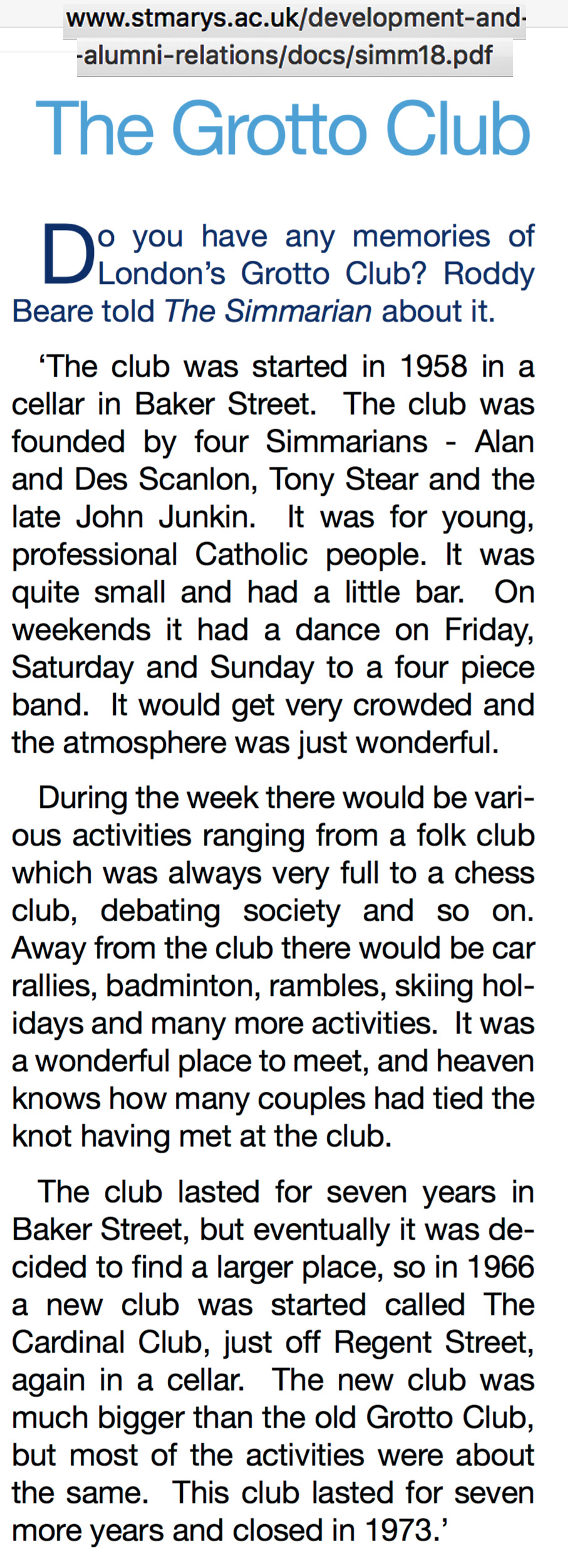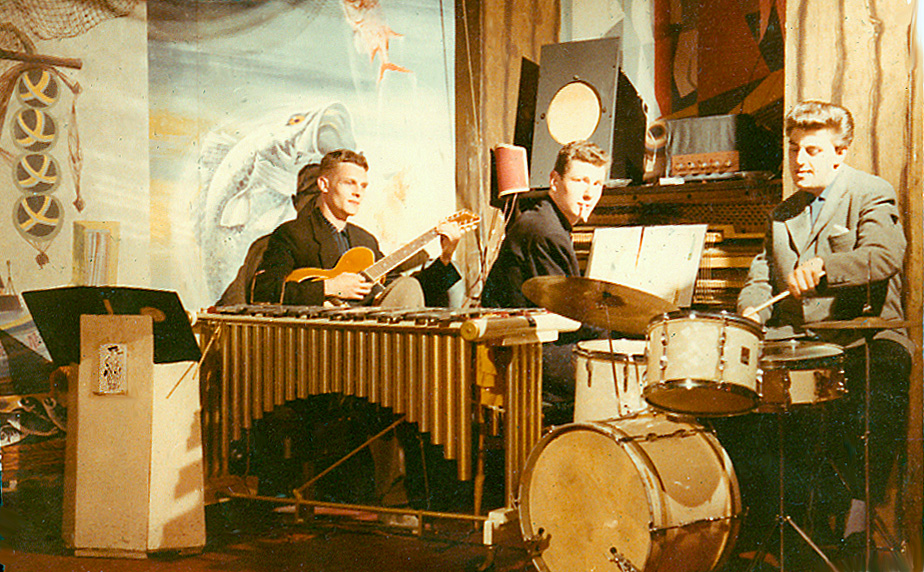
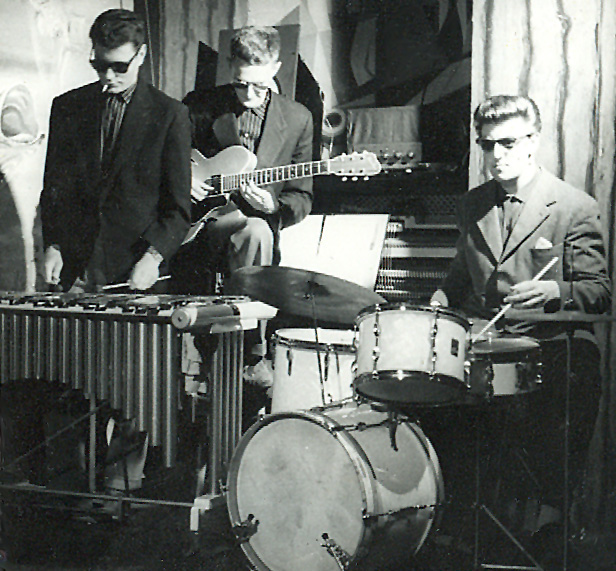
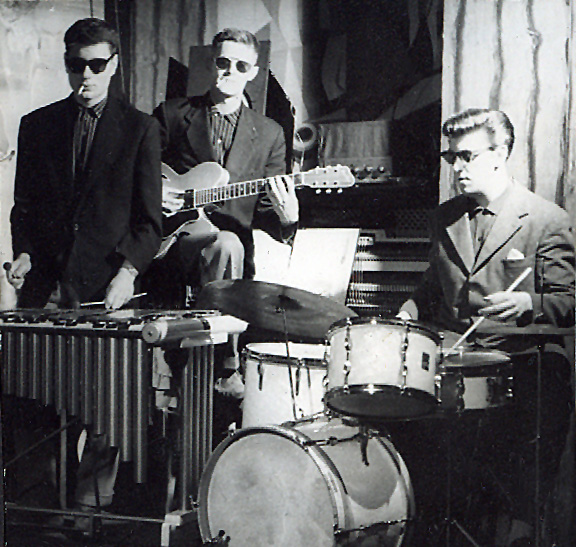
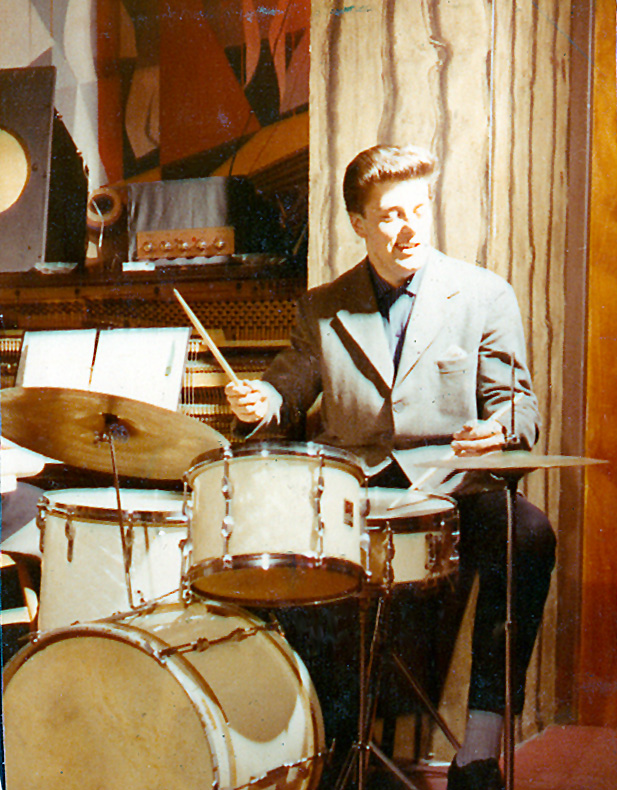
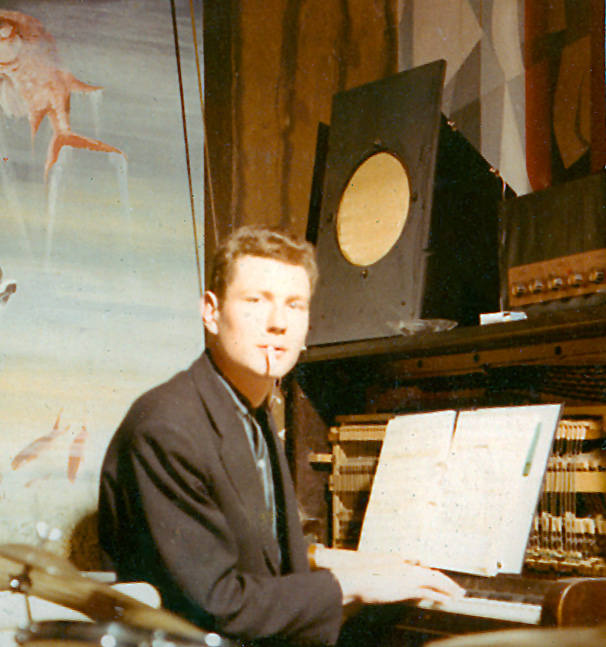
My good musician friend in 1958-9, Roger Coulam who went on to a career with the composing and directing orchestras etc. at the BBC. He was the pianist of the successful 1960s band 'Blue Mink', for which he wrote some hits. He also put out brilliant jazz.rock Hammond organ records.
|
 |
Contact Bob Priddy
- click here for e-mail address |
Click here to see reminiscence of The Grotto Club by the Simmarians
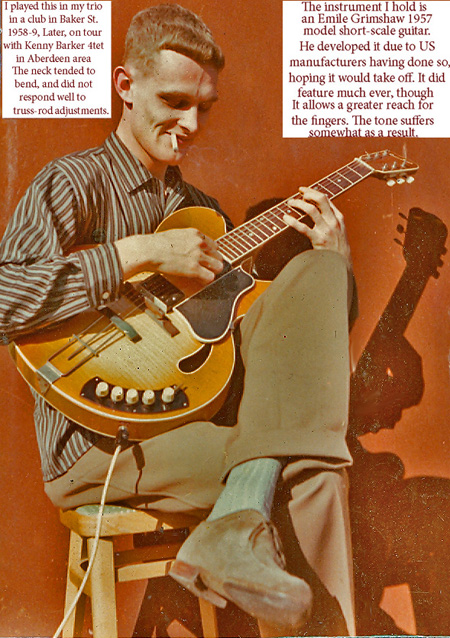
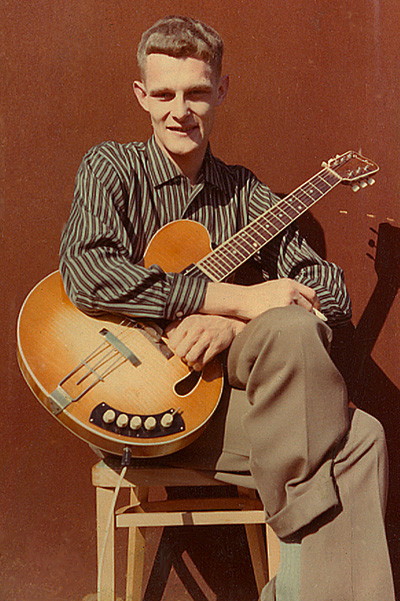
Playing my short-scale Grtimshaw guitar in 1959
It was the 'wizard of the electric guitar', Les Paul and the first ever multi-recordings that he also invented himself that first really inspired me, or rather, almost drove me half mad. Not only were they were a revelation in new electronic sounds, but they were also so varied, from the hauntingly tuneful to exciting jazziness. They set an impossible standard of guitar technique, due to speeded-up 'trick-recording', multi-tracking and electronic guitar gadgetry, and they also had a clarity and balance of sound that was hardly really achievable in live performance for several decades. The ideal they imprinted on my inner ear remained there somehow and it was only by studio methods that I eventually, forty years on, fulfilled those music-making ambitions as regards technique, sound quality and musical arrangement in a home multi-track studio.
When I first took up the guitar at school, it was mainly because of Les Paul. The guitar was an exotic instrument then, hardly anyone played one and various people seeing me carrying a guitar case still thought it was some kind of banjo or mandolin. I practiced in frustrating isolation, and not least on the ships I sailed in. I had a guitar amplifier custom built in 1954 (for use on ships with 110 volts DC) by some youngish technical wizard who was making a few in a basement workshop in Soho Square. It must have been one of the very first amplifiers with a built-in distortion circuit. It's designer and builder soon left to work on these in the US, I heard. On my next and last voyage on a tanker, the ship's electrician ruled the power point in my cabin and robbed me of amplification when he got fed up with my racket.
After leaving the RAF in 1957, my dream of becoming a musician were brought nearer to fruition through a slick barber in Charing Cross Rd. (could he have been related to Sweeny Todd?). One of his clients was, in his words, an illustrious session musician... a regular genius of the guitar, he claimed, called Ivor Mairants. I had to stay in the chair and take the full treatment before I learned enough... Mr. Mairants had a studio and was the top session musician in England on the guitar - as well as the banjo - and he was also the most used film guitarist at Pinewood studios etc. He gave lessons just behind the very barber's shop, in West St. just off Cambridge Circus. I discovered that Mairants was the acknowledged foremost session guitarist and guitar 'technician' in London. I took the bait and soon enrolled, after an audition with the great man himself. He was fairly encouraging but came down heavy on my thumb, which should have been invisible behind the fretboard. That was a big change I had to make. Though I could play a few Les Paul numbers and some classical pieces, he insisted that it was a no go if I did not learn to sight read. He could read complex pieces straight off the dots, most difficult when using a plectrum, and his studio was frequented by most of the leading guitarists of the day. Most were Jewish and some of them stood in for him and gave the occasional lesson too, so I learned from several professionals whom I would hear on the radio each week. It was an enticing small world to try to investigate, if only I could qualify. I progressed well enough, though the regime was too much bound to traditional methods like sight-reading and big band work for my liking. I aimed for more improvisational playing. In fact, it took me years to free myself from the creative constraints that way of playing tended to impose on me.
Emile Grimshaw had a guitar factory and a salesroom-office and workshop in Piccadilly. Mr. Grimshaw, whose father was and still is a recognished first genius of the banjo, told me that his dad had taught Ivor Mairants to play. I took that with a pinch of salt, but later disovered it is a known fact. Grimshaw junior was just about over the hill, and was not well-known as a player himself, though he could handle guitar, banjo and mandolin etc. I visited him often - the guitar boom was just beginning and Grimshaw's little factory somewhere began to turn out more and more on his expanding catalogue of models. He was a pleasant talker and I picked up various tips from him. model and bought three guitars from him in all, when I was no longer satisfied with my Hofner Consul electrified guitar, The Consul (I think the Hofner was called) was an arch-back guitar of the 'chello'style. I bought a brand new Grimshaw 'Commodore', which had all the trimmings an inlays possible, which reduced the sound or resonance a lot. When I showed it to Ivor Mairants (who was promoting Zenith guitars), he said it was more like a wedding cake than a guitar (but Polish-born Mairants and Grimshaw the younger were somewhat at loggerheads as business competitors of about the same age, both promoting different brands of guitar and both having been pupils of the elder Emile Grimshaw). I swapped in the Commodore and paid the difference to get the short scale Grimshaw electric gtr. seen below, plus an acoustic guitar he had just brought out called the Troubadour. This latter was very like the popular Martin acoustic, though with less neck (and hence string) tension, so easier to finger. It had a good tone but not all that powerful.
Emile Grimshaw was himself a player of diverse stringed instruments and issued the monthly BMG (Banjo, Mandolin, Guitar) Magazine, which contained music for some of his arrangements. He published banjo and guitar music, mainly his own arrangements or perhaps mainly those of his father, but also transcriptions of Eddie Lang classics (like 'April Kisses'). He may have issued a transcript of the Roy Smeck duet 'Stagefright'. Some of the arrangements were for two guitars and many were for the finger-picking style. They were very tasteful and they are no longer obtainable, as far as I can discover. Titles included: 'Stringin' Along', 'Lily of Laguna', 'Libestraum'. Mr. Emile Grimshaw was experimenting with new guitar types, solid body and short-scale etc. He invited me to join his (amateur but sight-reading) string trio, but it was a long journey to practices and I was not too keen all in all as they played from rather old-fashioned sheet music, close to ragtime. Two guitars I finally bought from him soon developed noticeable bends in the neck, making them look more suited to shooting arrows than playing on. Grimshaw tried to straighten the necks and even replaced one of them, but the same happened. The wood was not properly seasoned, due to the sudden national demand everyone strove to fulfil somehow. He was unwilling to right matters yet again, so I ended up with one instrument, him taking the other to pay for the neck replacement because I was too soft to stand up for my rights. That was when I realised that Mairants had been right and I ceased to call in at Grimshaw's office thereafter.
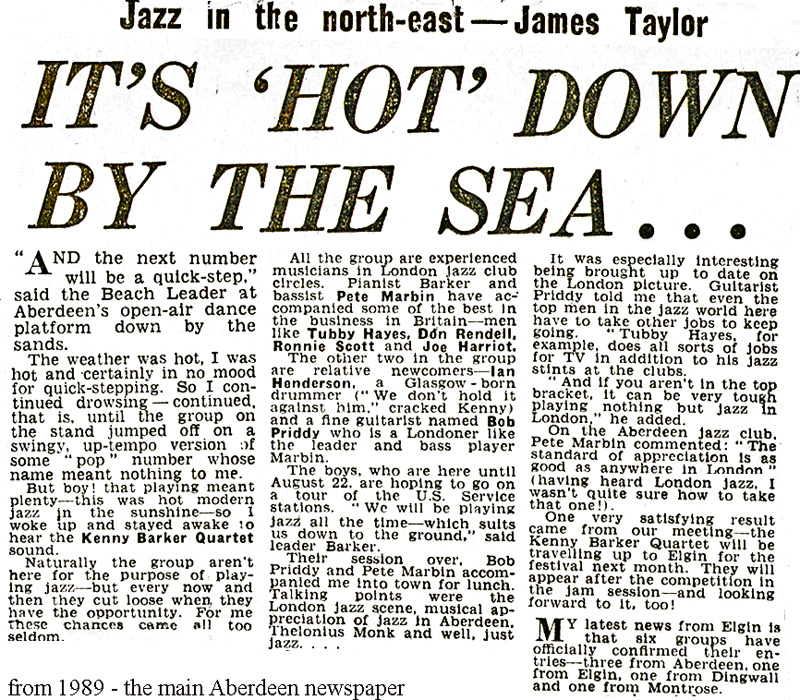
Some more ephemera for those cool Scots who have survived from the 1950s to the present. The 1959 Elgin Jazz Festival, whereour Kenny Barker Quartet
(with Pete Marbin bass and Tommy Henderson, drums, Kenny piano plus yours truly) was the featured group, was judged by a panel including Kenny Barker. A band which
copied the
intro. melody of the BBC's popular"Just Jazz" programme was awarded the top prize,
while a very good modern big band, the Vic Canale Band, came second. See news report:-
My guitar tutor, the hugely gifted Ivor Mairants 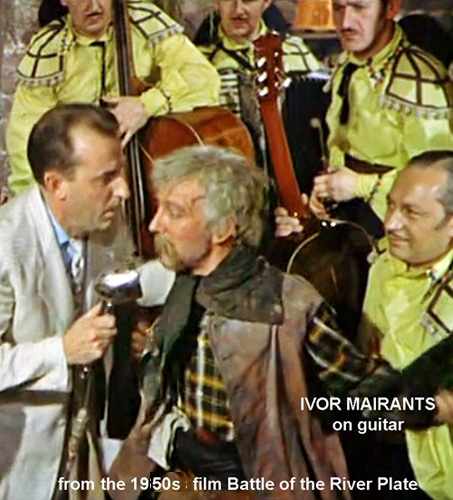 |
One of my friends and helpers in the London music gigging scene in the late 50s, Fred Donovan, who was a competant guitar player with a huge repertoire. He gigged most of his life in clubs and pubs around London. He was a very unselfish person and shared his knowledge with me freely. |