The Gormenghast Triology (Titus Groan, Gormenghast and Titus Alone)
The first two books of this trilogy are the major work, as most agree. What a major work too. This is not a traditional Gothic novel, though it has a setting and certain tortures and deaths which is Gothic. it is timeless, literally, in that one cannot pin down the place and events to any definitive period of history. No doubt Peake's childhood in China gave him a fundament, the despotic world with many attendant horrors, the redundant bureaucracy-feudalistic religion and social order… but it also reflects the colonial British Empire and the core values of 19th century English aristocracy. (Some would say still there beneath the gloss). It has much of the essence of Napoleonism, also of Stalinism, Maoism and Islamic fundamentalism (Barquentine, the master of all rituals, is as a mullah in full poisonous flower). It is a symbol of common human social conditions, but cannot be placed in any country or even era, yet much of it is nonetheless recognisible. The writing is very graphically descriptive but is not therefore boring. It can seem long-winded at times, but it depicts the sprawl of sub-cultures and sub-plots that take place there. Though it is about a non-existent mini-world, it shows a penetrating knowledge of many aspects of human life, the turmoils of confused relationships and the search for meaning with a sharp eye for social inertia, futile religions, outworn ritual, and social revolt. Peake's originality of imagery and metaphor combined with realism make it a much deeper than, say, The Lord of the Rings, which small masterpiece relies too much on magic, romantic fantasy and traditional heroism.
That Titus Groan is a central character comes of the core fact of Gormenghast, the rule of primogeniture, about which the plot revolves. The third volume (Titus Alone) had to be written, even though Peake was suffering from Parkinson's disease whereby he lost touch more and more with the world, because without it there would have been no realisation of freedom, rejection of the entire old order… despite the sad and often unacceptable consequences of this, as Titus Groan undergoes in his roaming of the world.
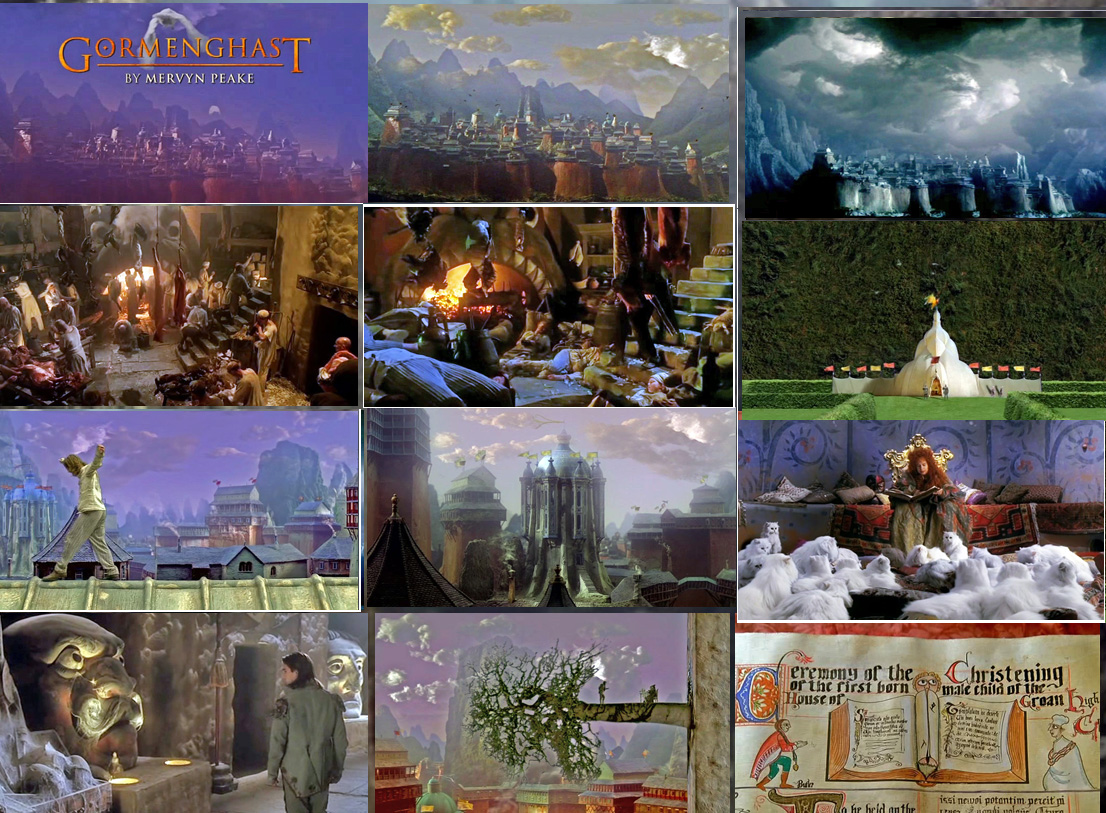
The BBC series in four parts (with an additional part with interviews of the cast) is literally an amazing production which can surely never be surpassed. After having read the book, the film is true to the book while it supplements the visual imagination with prime character acting, remarkable costumes and effects, strange architecture and peculiar events. Not only did it come out in 2000, like a closing comment on the previous century by those who had lived through most of it, but it employed some of Britain's most gifted character actors and especially the comic ones. Sir Spike Milligan, Eric Sykes, Stephen Fry, Michael Clunes to name just a few. Acting the unprecedented characters of Peake's imaginative humour, pathos and horror called on reserves of expression which had few if any forerunners to instruct the actors. I give this the maximum praise, both book and film, and one can hardly ever say that these days.