A STORE-HOUSE of 'SWEET MUSIC
A Glimpse at the Pianos Family History -- The Care and Experience that are Needed lo Produce the Splendid Full-toned Instruments that We Hear To-day
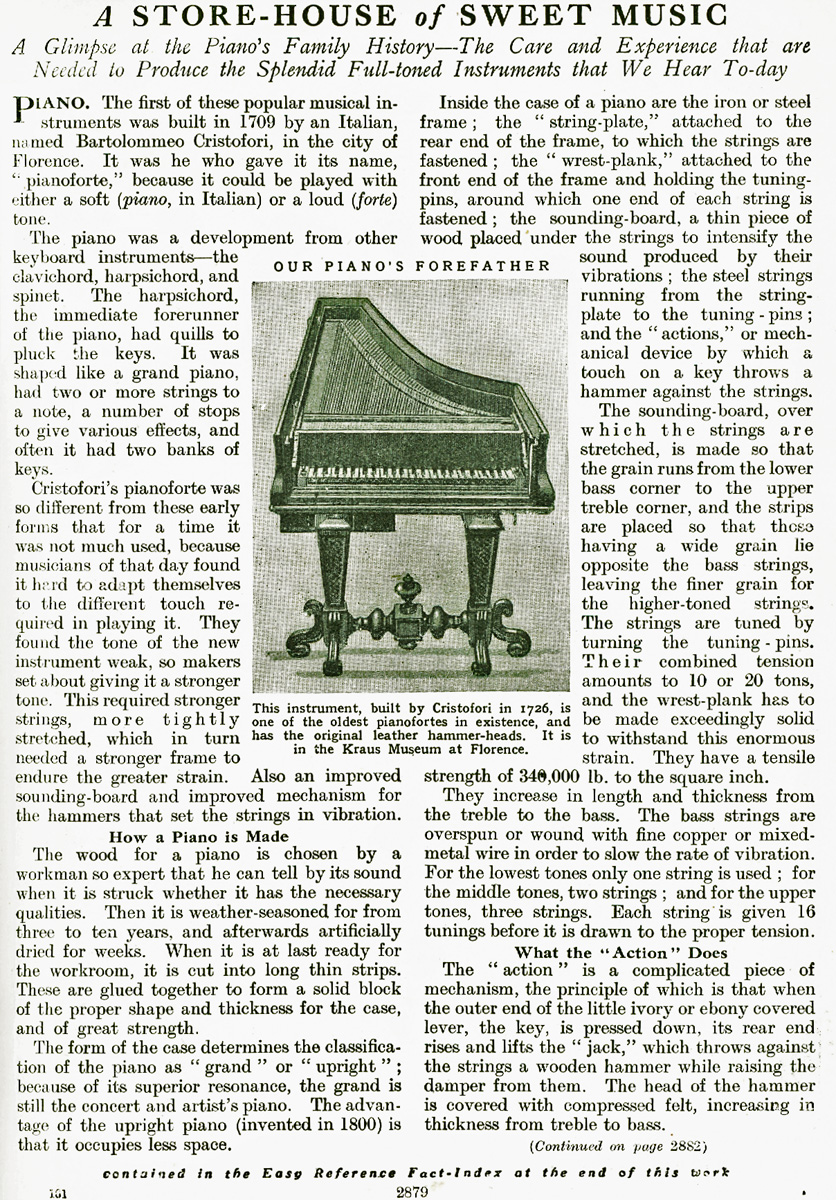
PIANO. The first of these popular musical instruments was built in 1709 by an Italian, named Bartolomrneo Cristofori, in the city of Florence. It was he who gave it its name, “ pianoforte,” because it could be played with either a soft (piano, in Italian) or a loud (forte)tone.
The piano was a development from other keyboard instruments - the clavichord, harpsichord, and spinet. The harpsichord, the immediate forerunner of the piano, had quills to pluck the keys. It was shaped like a grand piano, had two or more strings to a note, a number of stops to give various effects, and often it had two banks of keys.
Cristofori’s pianoforte was so different from these early forms that for a time it was not much used, because musicians of that day found it hard to adapt themselves to the different touch required in playing it. They found the tone of the new instrument weak, so makers set- about giving it a stronger tone. This required stronger strings, more tightly stretched, which in turn needed a stronger frame to endure the greater strain.
How a Piano is Made
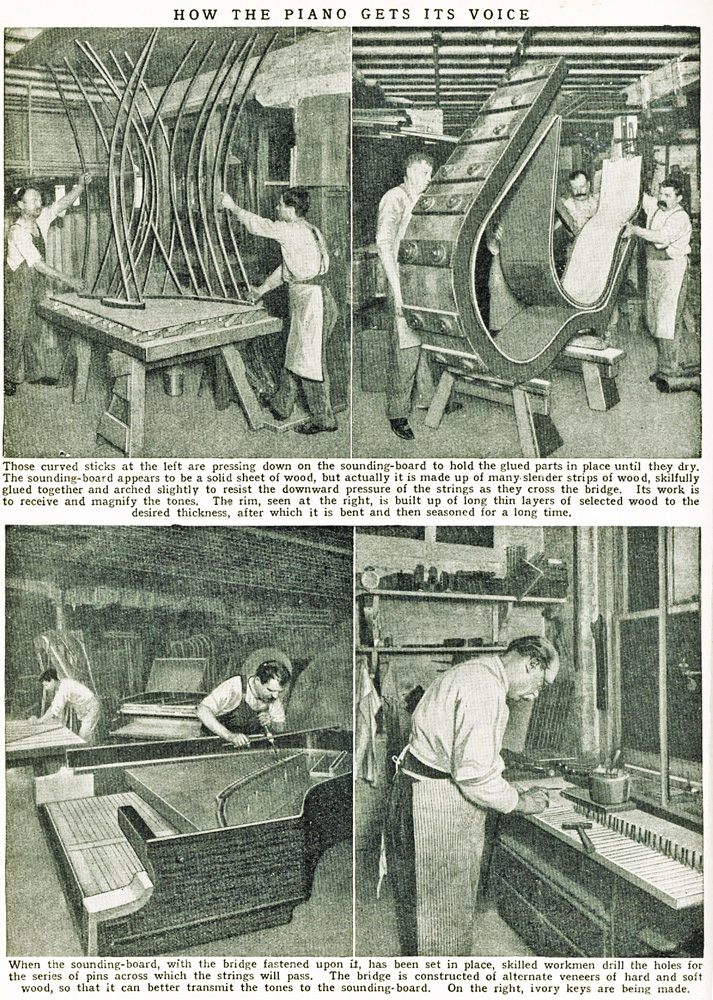
The wood for a piano is chosen by a Workman so expert that he can tell by its sound when it is struck whether it has the necessary qualities. Then it is weather-seasoned for from three to ten years, and afterwards artificially dried for weeks. When it is at last ready for the workroom, it is cut into long thin strips. These are glued together to form a solid block
of the proper shape and thickness for the case, and of great strength.
The form of the case determines the classification of the piano as “ grand ” or “ upright ” ; because of its superior resonance, the grand is still the concert and artist’s piano. The advantage of the upright piano (invented in 1800) is that it occupies less space.
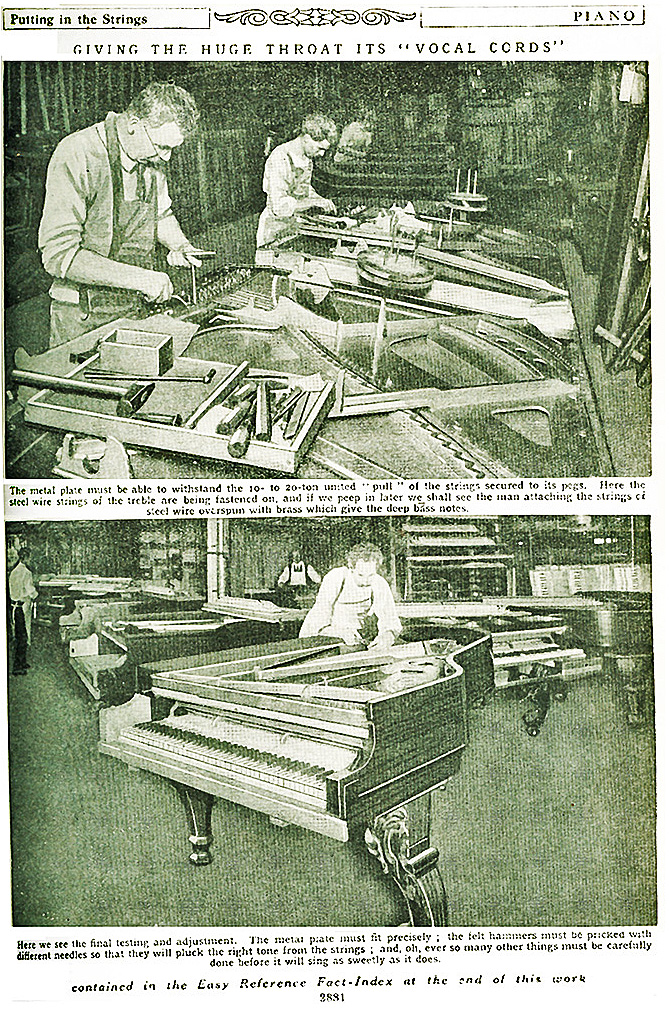
Inside the case of a piano are the iron or steel frame ; the “ stringplate,” attached to the rear end of the frame, to which the strings are fastened; the “ wrest-plank,” attached to the front end of the frame and holding the tuning- pins, around which one end of each string is fastened; the sounding-board, a thin piece of wood placed 'under the strings to intensify the keyboard instruments-the clavichord, harpsichord, and spinet The harpsichord, the immediate forerunner of the piano, had quills to pluck the keys. It was shaped like a grand piano, had two or more strings to a note, a number of stops to give various effects, and often it had two banks of keys.